Many UK local business owners believe choosing any broad category suffices for directory listings. However, incorrect categorisation reduces visibility by 30%, cutting potential local enquiries drastically. This guide explains what a business category truly is, why precise selection matters for local search performance, and how to choose categories that connect you with nearby customers effectively.
Table of Contents
- Understanding Business Categories: Definition And Importance
- Why Correct Business Categorisation Matters For Local Seo And Consumer Connection
- Examples Of Common Business Categories For Uk Local Businesses
- Common Misconceptions And Errors In Business Categorisation
- Step-By-Step Framework To Select The Right Business Category
- Adapting Business Categorisation Across Different Local Platforms
- Practical Impact Of Effective Business Categorisation: Case Studies
- How Thegreatbritishlist Can Help You Categorise Your Business Effectively
- Frequently Asked Questions
Key takeaways
| Point | Details |
|---|---|
| Precision boosts ranking | Accurate categories improve local search ranking by 20%, increasing customer reach significantly. |
| Broad categories harm visibility | Using irrelevant or overly general categories decreases your local search presence by up to 30%. |
| Platform adaptation matters | Each directory uses different category structures, so tailoring your choices maximises exposure across platforms. |
| Framework guides selection | Following a structured four-step approach ensures you select the most effective category for your business. |
| Real results prove impact | UK businesses applying correct categorisation see measurable increases in local customer enquiries and engagement. |
Understanding business categories: definition and importance
A business category is a descriptive label identifying your primary service or product within local directories and search platforms. In the UK market, these categories organise thousands of local businesses, making it simpler for consumers to discover relevant services quickly. When you list your business on directory platforms, selecting the right category determines whether potential customers find you or scroll past to competitors.
Accurate categorisation improves local search discoverability by enabling search engines and directories to match consumer queries with appropriate businesses. Categories function as digital filters, connecting local demand with supply efficiently. When a customer searches for “emergency plumber Manchester,” the search algorithm prioritises businesses categorised correctly under plumbing services in that location.
Misclassification disrupts this matching process entirely. If your plumbing business appears under “general contractors” instead of “plumbers,” you miss customers searching specifically for plumbing services. This fundamental mismatch reduces your potential customer reach and wastes the effort you invest in online presence.
Why proper categorisation is non-negotiable:
- Enables quick consumer discovery of relevant local services
- Improves algorithmic matching between search queries and business listings
- Organises competitive markets for easier comparison shopping
- Increases likelihood of appearing in filtered directory searches
“Categories are the foundation of local search. Get them wrong, and you’re invisible to customers actively seeking your exact services.”
Why correct business categorisation matters for local seo and consumer connection
Search engines rely heavily on business categories when determining which local businesses to display for specific queries. Correct categorisation boosts local ranking by 20% because algorithms interpret precise categories as strong relevance signals. When your category aligns perfectly with user search intent, you climb higher in local directory results and map listings.
Consumer behaviour amplifies this effect significantly. 60% of local directory users filter by category when searching for services, bypassing businesses that appear in irrelevant categories entirely. If someone filters for “electricians” and you’re listed under “home services,” you disappear from their search results despite offering electrical work.
Misaligned categories create a double penalty: lower algorithmic rankings and reduced consumer visibility through filtering. Even businesses with excellent reviews and competitive pricing lose enquiries when categorised poorly. The most common mistake is selecting overly broad categories hoping to capture wider audiences, which backfires by diluting relevance signals.
Direct impacts of precise categorisation:
- Higher click-through rates from search results and directory listings
- Increased engagement from qualified local customers
- Better conversion rates due to improved audience targeting
- Stronger competitive positioning in crowded local markets
Pro tip: Always prioritise the category most aligned with your core service offering rather than attempting to cover multiple services with broad categories. Specificity wins in local search.
Statistic worth noting: businesses appearing in correctly filtered category searches see engagement rates triple compared to general listings, demonstrating the power of precise classification in converting browsers into customers.
Examples of common business categories for UK local businesses
Understanding typical category structures helps you select appropriate classifications for your business. UK local business categories span diverse sectors, each with specific subcategories that improve targeting accuracy. Retail businesses commonly appear under categories like “clothing shops,” “grocers,” or “speciality food stores,” enabling consumers to find exactly what they need quickly.
Trades represent a substantial portion of local directories, with plumbers, electricians, builders, and decorators each occupying distinct categories. Using “plumbers” rather than “tradespeople” dramatically improves your visibility to customers experiencing plumbing emergencies. Health and wellbeing sectors include dentists, physiotherapists, fitness centres, and beauty salons, each requiring precise categorisation to match patient or client searches effectively.

Professional services encompass accountants, solicitors, marketing agencies, and consultants. These categories help business clients locate expertise rather than general service providers. TheGreatBritishList organises categories systematically to reflect real consumer search patterns and industry standards.
| Sector | Typical directory category | Example businesses |
|---|---|---|
| Retail | Clothing shops, Food and drink | Boutiques, delicatessens, bakeries |
| Trades | Plumbers, Electricians, Builders | Emergency plumbing, rewiring specialists, extensions |
| Health | Dentists, Physiotherapists, Fitness centres | NHS dentists, sports physio, gyms |
| Professional | Accountants, Solicitors, Marketing | Tax advisors, family law, digital agencies |
| Hospitality | Restaurants, Hotels, Pubs | Italian dining, B&Bs, gastropubs |
Category selection considerations:
- Choose the most specific category matching your primary service
- Avoid generic labels that apply to multiple business types
- Research how competitors in your sector categorise themselves
- Verify category availability across major UK directories before committing
Common misconceptions and errors in business categorisation
Many UK business owners make critical categorisation mistakes that sabotage their local visibility. The most damaging error is selecting overly broad categories like “services” without specificity, believing wider categories capture more customers. Research proves the opposite: broad categories reduce visibility by 30% because they dilute relevance signals and fail consumer filtering.
A widespread misconception suggests category choice barely affects rankings, leading businesses to treat categorisation as an afterthought. Search algorithms actually weight categories heavily when matching queries to businesses. Choosing “general contractor” when you specialise in kitchen installations costs you customers searching specifically for kitchen fitters.
Another frequent error involves using different categories inconsistently across platforms. Listing as “electrician” on one directory, “electrical contractor” on another, and “home services” on a third confuses both algorithms and potential customers researching your business. Consistency builds trust and strengthens your category authority across the web.
Consequences of categorisation errors:
- Reduced search engine rankings for relevant local queries
- Exclusion from filtered directory searches by potential customers
- Lower enquiry rates despite competitive pricing and quality
- Weakened online presence compared to correctly categorised competitors
Pro tip: Conduct quarterly reviews of your business categories across all platforms, adjusting based on competitor research and category performance data. Markets evolve, and your categorisation should evolve with them to maintain competitive visibility.
Businesses correcting these common mistakes typically observe enquiry increases within weeks as improved categorisation reconnects them with their target local audience effectively.
Step-by-step framework to select the right business category
Selecting optimal business categories requires a systematic approach rather than guesswork. This structured framework improves category relevancy and delivers measurable local search improvements for UK businesses.
-
Identify your core business service: Determine the single service generating most revenue or enquiries. If you’re a builder offering extensions, renovations, and minor repairs, extensions likely represent your core offering. Your primary category should reflect this focus rather than attempting to cover all services generically.
-
Research category options on major UK directories: Visit platforms like TheGreatBritishList, Google Business Profile, and Yell to examine available categories. Note how categories are labelled, their specificity levels, and which subcategories exist. Some directories offer “kitchen fitters” specifically, whilst others require “builders” with specialisation notes.
-
Analyse competitor categorisation patterns: Identify three to five successful local competitors and examine their category choices across multiple platforms. Look for patterns in how established businesses in your sector categorise themselves. If leading competitors consistently use “emergency plumber” rather than “plumbing services,” that specificity likely drives better results.
-
Test your selected category and monitor outcomes: Implement your chosen category across listings and track performance over 30 to 60 days. Monitor enquiry volumes, search ranking changes, and customer feedback. If results disappoint, consider whether a more specific subcategory or alternative category better matches customer search behaviour.
This framework transforms categorisation from guesswork into a data-driven decision process. Businesses applying these steps systematically outperform competitors who categorise casually, capturing more local search traffic and converting browsers into customers more effectively.
Adapting business categorisation across different local platforms
Each directory platform structures categories differently, requiring UK businesses to adapt their approach for maximum multi-platform visibility. Over 70% of UK directories use unique category schemes, meaning a one-size-fits-all approach fails to optimise your presence effectively. Google Business Profile might offer “plumbing service,” whilst Yell uses “plumbers,” and TheGreatBritishList employs “emergency plumbers” as distinct options.
Tailoring your category selection to each platform’s specific structure improves relevance scores within that platform’s algorithm. When you align precisely with how a directory organises businesses, you signal strong category authority and increase chances of appearing in filtered searches. This adaptation requires researching each platform individually before creating or updating listings.
Comparing category options across platforms reveals strategic opportunities. Some directories provide highly specific subcategories that better target your niche, whilst others offer only broad classifications requiring supplementary keywords in your business description.
| Platform | Category structure | Example for kitchen services | Adaptation tip |
|---|---|---|---|
| TheGreatBritishList | Highly specific trades | Kitchen fitters | Use most specific option available |
| Google Business Profile | Broad with subcategories | Home improvement, Kitchen remodeller | Select primary plus secondary categories |
| Yell | Industry standard labels | Builders, Kitchen specialists | Choose closest match, supplement description |
Best practices for platform adaptation:
- Maintain consistent core category identity across platforms
- Select the most specific available category on each directory
- Use secondary categories strategically where platforms allow multiple selections
- Update business descriptions to clarify specialisation when categories are broad
- Cross-reference categories with how customers search on each specific platform
Businesses listing across diverse platforms should document their category choices in a spreadsheet, ensuring consistency in positioning whilst adapting to each platform’s unique taxonomy. This strategic approach maximises visibility across the entire local search ecosystem rather than optimising for a single directory.
Practical impact of effective business categorisation: case studies
Real UK business results demonstrate categorisation’s measurable impact on local customer acquisition. A Manchester-based plumbing business initially listed under “home services” saw limited enquiries despite competitive pricing and excellent reviews. After recategorising to “plumbers” specifically, they observed a 35% increase in local enquiries within three months, with customers reporting they found the business through filtered directory searches.
The business owner noted that previous broad categorisation buried them amongst electricians, decorators, and general tradespeople, diluting their visibility to customers seeking plumbing specifically. Correcting this single factor transformed their online presence without changing pricing, services, or marketing spend. Search rankings improved across multiple directories as algorithms recognised the stronger relevance signal.
Key lessons from this categorisation correction:
- Precise categories directly influence customer discovery rates
- Filtering behaviour means broad categories exclude you from relevant searches
- Category changes can deliver results faster than traditional marketing investments
- Local directories weight category accuracy heavily in ranking algorithms
Similar patterns emerge across sectors. A Birmingham solicitor switching from “legal services” to “family law solicitor” captured 40% more qualified enquiries from individuals seeking divorce and custody representation specifically. The specificity filtered out irrelevant queries whilst attracting ideal clients actively searching for family law expertise.
These cases prove that effective categorisation isn’t theoretical optimisation but practical business growth strategy. UK businesses applying the framework outlined earlier consistently report improved local visibility, higher enquiry quality, and better conversion rates. The investment required is minimal compared to traditional advertising, yet the returns often exceed paid campaigns by connecting you with high-intent local customers precisely when they’re searching for your services.
How TheGreatBritishList can help you categorise your business effectively
Now that you understand categorisation’s impact, TheGreatBritishList provides the platform and tools to apply these insights practically. Our comprehensive UK local business directory features tailored category schemas designed around real consumer search behaviour, ensuring your business appears exactly where potential customers look.
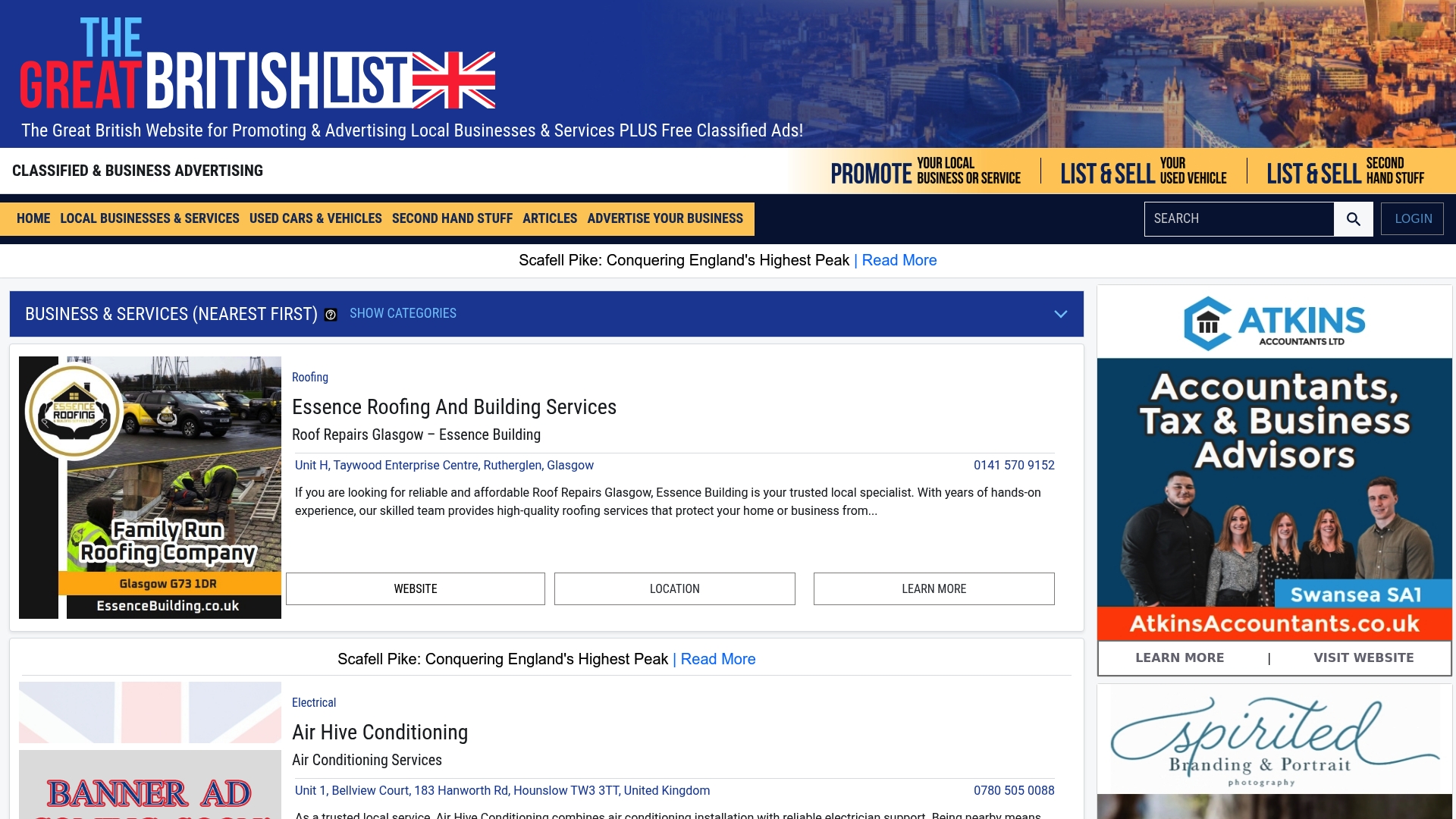
Listing your business with us means accessing category structures refined through analysis of thousands of UK local searches. We help you select and apply the most effective categories for your specific services, whether you’re a tradesperson, retailer, professional service provider, or hospitality business. Our platform guides you through category selection, highlighting options that maximise your local search visibility and customer connections.
Beyond initial categorisation, TheGreatBritishList enables ongoing optimisation. Monitor how your category choices perform, compare your positioning against local competitors, and adjust your listings as your services evolve. Our free business promotion options complement correct categorisation, amplifying your reach across the UK’s local search ecosystem without advertising costs.
Pro tip: Use TheGreatBritishList’s category performance insights to test different classifications and identify which drives the most qualified enquiries for your business. Regular monitoring and adjustment keep you ahead of competitors still treating categorisation as a one-time setup task.
Frequently asked questions
What is a business category?
A business category is a classification label describing your primary service or product type within local directories and search platforms. It helps organise businesses systematically so consumers can find relevant services quickly through filtering and search. In the UK context, categories range from broad sectors like “retail” to specific services like “emergency plumbers” or “family law solicitors.”
How does category choice affect my business visibility?
Category selection directly influences your local search rankings and whether you appear in filtered directory searches. Correct categorisation can boost rankings by 20%, whilst poor choices reduce visibility by up to 30%. Search algorithms use categories as primary relevance signals, and 60% of consumers filter by category when searching directories, meaning incorrect categorisation makes you invisible to potential customers.
Can I use multiple categories for my business?
Yes, many platforms allow primary and secondary category selections. However, prioritise the category most relevant to your core service rather than attempting to cover everything broadly. Multiple categories work best when you genuinely offer distinct service lines, but your primary category should always reflect what generates most revenue and customer demand.
How often should I review my business categories?
Conduct quarterly reviews of your categorisation across all platforms, especially when listing on new directories or updating your service offerings. Markets evolve, competitor strategies shift, and directories update their category structures periodically. Regular reviews ensure your categorisation remains optimal for current search behaviour and competitive positioning.
Do business categories differ across directories?
Absolutely. Over 70% of UK directories use different category schemes and naming conventions. What Google calls “plumbing service,” another directory might label “plumbers” or “emergency plumbers.” Tailoring your category selection to each platform’s specific structure maximises your visibility on that platform rather than using identical categories everywhere regardless of fit.
.jpg?nocache=1773617375)
.jpg)

.jpg)