Many consumers assume main dealers always deliver superior service and value, but independent garages charge significantly less for identical work. A major service for a Ford Fiesta costs £208 to £290 at local independents versus £551 at main dealers, revealing price differences that can reshape your budget. This guide shows how comparing local service providers saves money, builds trust through verified reviews, and connects you with quality professionals. You’ll discover practical strategies to evaluate both price and reputation, ensuring every pound spent delivers genuine value while supporting your community.
Table of Contents
- Understanding The Real Cost Differences In Local Services
- Building Trust Through Reviews And Local Reputation
- Balancing Price And Quality: Making Informed Local Service Choices
- Applying Comparison Strategies To A Range Of Local Services
- Discover Trusted Local Services Near You Today
- FAQ
Key takeaways
| Point | Details |
|---|---|
| Compare for value | Comparison reveals substantial price differences and quality variations among local providers. |
| Reviews drive trust | 86% of consumers read reviews before hiring, averaging 10 reviews per decision. |
| Independents save money | Local garages offer major savings over main dealers on car servicing and repairs. |
| Quick decisions | 78% of local mobile searches convert to purchases within 24 hours after research. |
Understanding the real cost differences in local services
The price gap between local independents and national chains often surprises consumers who assume bigger names guarantee better value. Independent garages charge significantly less than main dealers for car servicing, with major services costing £208 to £290 versus £551 at dealerships. This pattern extends across home maintenance, personal care, and professional services where local providers frequently undercut corporate competitors by 30% to 60%.
Consider these typical cost comparisons across common local services:
| Service Type | Main Dealer/Chain | Local Independent | Potential Savings |
|---|---|---|---|
| Car major service (Ford Fiesta) | £551 | £208-£290 | £261-£343 |
| Interior painting (3-bed house) | £2,800-£3,500 | £1,800-£2,400 | £1,000-£1,100 |
| Garden landscaping (50m²) | £4,500-£6,000 | £3,200-£4,200 | £1,300-£1,800 |
| Wedding photography (8 hours) | £2,000-£3,000 | £1,200-£1,800 | £800-£1,200 |
These savings accumulate rapidly when you consider multiple services throughout the year. A household using local providers for car maintenance, painting services, and garden work could save £2,500 to £4,000 annually compared to branded alternatives.
Price differences stem from several structural factors. Local businesses operate with lower overheads, avoiding corporate marketing budgets and franchise fees that inflate chain pricing. Independent professionals often work from home workshops or small premises, passing rental savings directly to customers. Many local providers also purchase materials through trade accounts at better rates than consumers can access, sharing these advantages through competitive quotes.
Pro Tip: Request itemised quotes from both local independents and chains for identical services. Compare labour rates separately from materials to identify where savings originate and verify you’re receiving equivalent quality specifications.
Beyond pure cost, local providers deliver personalised service that larger organisations struggle to match. Independent joinery and carpentry services typically assign the same craftsperson throughout your project, building continuity and accountability. You communicate directly with the person doing the work rather than navigating call centres or account managers. This relationship often results in flexible scheduling, custom solutions, and genuine care for reputation within the local community.
Quality concerns sometimes deter consumers from choosing cheaper local options, but price alone doesn’t determine workmanship standards. Many independent professionals trained at the same institutions as corporate employees and maintain identical certifications. The key lies in verification through reviews, credentials, and guarantees rather than assuming price reflects quality.
Building trust through reviews and local reputation
Online reviews have transformed how consumers evaluate local service providers, creating transparency that protects buyers and rewards quality businesses. 86% of consumers read online reviews before trusting local home service providers, with the average person consulting 10 reviews before making hiring decisions. This behaviour reflects a fundamental shift from relying on yellow pages or word of mouth to demanding verifiable customer experiences.

Reviews serve multiple functions beyond simple star ratings. They reveal how businesses handle problems, communicate during projects, and deliver on promises. A five-star rating with generic praise carries less weight than four stars with detailed accounts of punctuality, cleanliness, and problem-solving. You gain insight into whether a local architectural service responds professionally to design changes or if cleaning services consistently arrive on schedule.
The speed at which consumers act after researching reviews demonstrates their decision-making power. 78% of local mobile searches lead to purchase within 24 hours, showing that once trust is established through reviews, consumers move quickly. This rapid conversion means your comparison process should focus on quality signals rather than endless deliberation.
Evaluate reviews strategically using these criteria:
- Recency: Prioritise reviews from the past 12 months reflecting current service standards
- Detail: Look for specific descriptions of work completed, timelines met, and communication quality
- Response patterns: Check if businesses reply professionally to both positive and negative feedback
- Volume: A steady stream of reviews indicates ongoing business activity and customer satisfaction
- Consistency: Similar praise or concerns across multiple reviews reveal reliable patterns
Pro Tip: Search for the business name plus “review” on multiple platforms including Google, Trustpilot, and Checkatrade. Cross-referencing prevents manipulation and provides a fuller picture than single-platform ratings.
Authenticity matters when assessing reviews. Genuine feedback includes imperfections, specific project details, and balanced perspectives. Be cautious of exclusively five-star ratings with vague language or clusters of reviews posted within days. Legitimate businesses accumulate reviews gradually with natural variation in customer experiences and writing styles.
Local reputation extends beyond online reviews into community presence. Providers active in local business associations, sponsoring community events, or maintaining long-term premises demonstrate commitment beyond quick profits. These indicators complement digital reviews, especially for services where online presence may be limited but local standing is strong.
Balancing price and quality: making informed local service choices
Price comparison alone creates incomplete decisions that may sacrifice quality or overlook community benefits. Some experts warn over-reliance on price ignores quality and community advantages of local providers, noting independent mechanics charge £47 per hour versus £99 at dealers while delivering comparable work. This balance between cost savings and service excellence requires evaluating multiple factors simultaneously.
Local businesses contribute to community vitality in ways corporate chains cannot replicate. Money spent with independent providers circulates locally through wages, supplies, and services, strengthening the regional economy. Personal relationships develop when your gardening service knows your property’s quirks or your removal company remembers your previous move. These intangible benefits add value beyond invoice totals.
Insurance industry reforms highlight why comparison remains essential despite quality considerations. Price-walking practices where insurers gradually increased renewal premiums for loyal customers prompted regulatory intervention, demonstrating that even established providers may not offer fair value without consumer vigilance. This principle applies across local services where complacency about pricing can cost hundreds annually.
Balance price and quality using this systematic approach:
- Define your project requirements and quality standards before requesting quotes
- Obtain at least three comparable estimates from local providers
- Verify credentials, insurance coverage, and relevant certifications for each
- Review customer feedback focusing on projects similar to yours
- Assess communication quality and responsiveness during the quote process
- Compare warranty terms and guarantees offered with each proposal
- Calculate total cost including materials, labour, and potential extras
- Weight price against reputation, experience, and gut feeling about trustworthiness
Pro Tip: Ask providers about their warranty policies and how they handle issues after completion. A slightly higher quote with comprehensive guarantees often delivers better value than the cheapest option with no recourse.
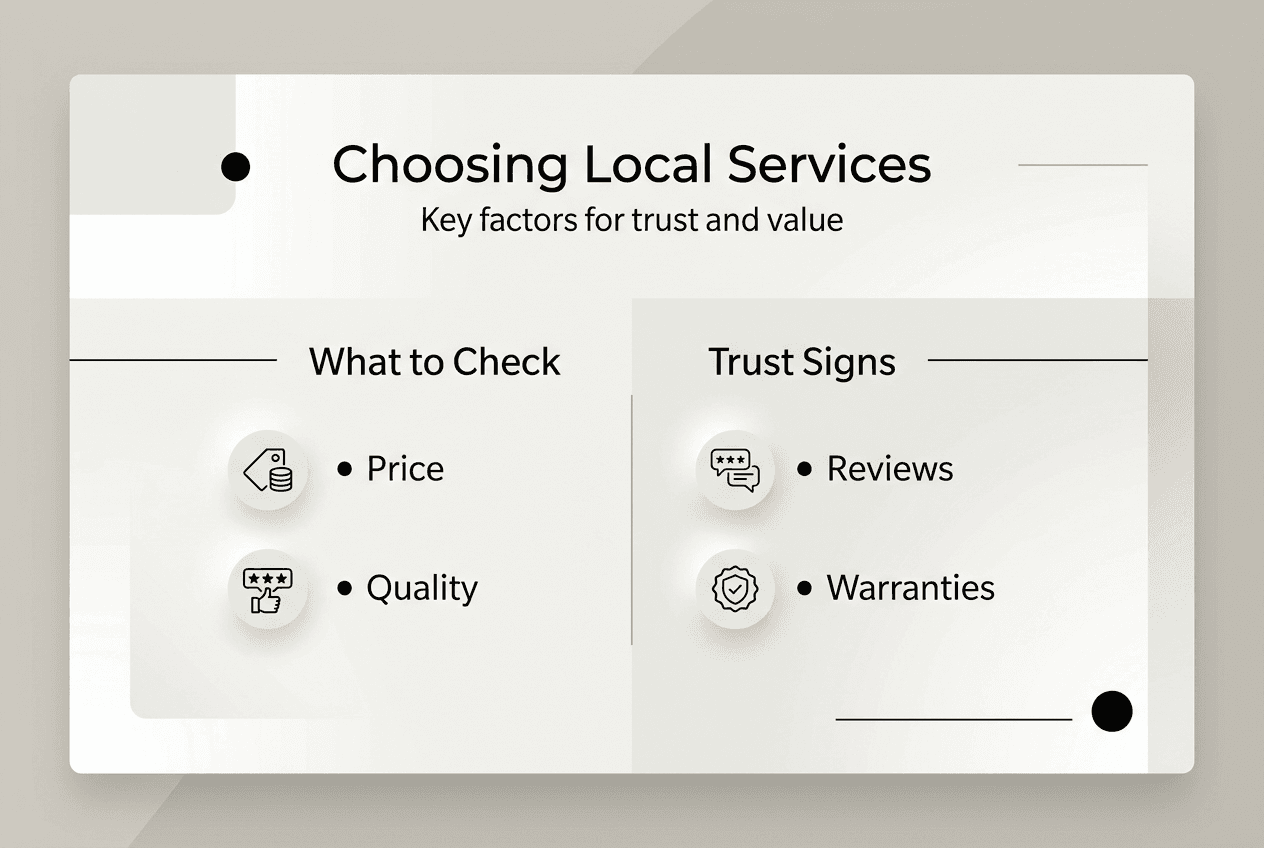
Quality indicators extend beyond price to include professional presentation, detailed quotes, and transparent communication. Legitimate professionals provide written estimates specifying work scope, materials, timelines, and payment terms. They answer questions thoroughly, offer references willingly, and maintain proper insurance. These signals help distinguish skilled craftspeople from unreliable operators regardless of pricing.
| Factor | What to Assess | Red Flags | Green Flags |
|---|---|---|---|
| Price | Competitive within market range | Significantly below average | Itemised, justified costs |
| Credentials | Relevant qualifications, insurance | Vague about certifications | Provides documentation readily |
| Communication | Responsiveness, clarity | Slow replies, unclear terms | Prompt, detailed responses |
| Reviews | Consistent positive feedback | No online presence | Recent, detailed testimonials |
| Guarantees | Written warranty terms | No guarantee offered | Clear warranty period |
Your decision framework should weight factors according to project risk and complexity. Simple tasks like garden maintenance tolerate more price sensitivity than structural work requiring guaranteed quality. High-stakes services demand thorough vetting even if it means paying moderate premiums for proven reliability.
Applying comparison strategies to a range of local services
Local service searches convert rapidly once consumers complete their research, making efficient comparison critical. 78% of local mobile searches lead to purchase within 24 hours, demonstrating that streamlined evaluation processes help you secure quality providers before availability disappears. This urgency requires systematic approaches adaptable across service categories from home improvements to personal care.
Effective comparison begins with clear requirements and realistic budgets. Define exactly what you need before contacting providers to ensure quotes address identical scopes. A vague request for “kitchen renovation” generates incomparable estimates, while specifying “replace 8 cabinet doors, install new worktop, repaint walls” produces actionable quotes. This clarity prevents misunderstandings and enables genuine price comparison.
Shortlist providers using these research methods:
- Search local directories like The Great British List for verified businesses in your area
- Request recommendations from neighbours who recently used similar services
- Check professional association memberships indicating industry standards compliance
- Review social media presence for recent project photos and customer interactions
- Verify business registration and insurance through official databases
Different service categories require adapted comparison approaches. Home improvement projects demand detailed written quotes, site visits, and material specifications. Personal services like wedding photographers require portfolio reviews, personality compatibility, and package comparisons. Professional services such as carpentry benefit from examining previous work samples and discussing custom requirements.
Use this actionable comparison checklist:
- Identify three to five providers within your budget range and location
- Request detailed quotes specifying all costs, timelines, and deliverables
- Verify credentials, insurance, and relevant trade certifications
- Read minimum 10 recent reviews per provider across multiple platforms
- Contact references from previous customers with similar projects
- Assess communication quality and professionalism during initial interactions
- Compare total value including warranties, materials quality, and experience
- Trust your instinct about reliability and compatibility
- Confirm availability aligns with your project timeline
- Secure written agreements before work commences
Timing influences comparison success significantly. Book popular services like landscaping or photography months ahead during peak seasons to ensure availability and avoid rushed decisions. Emergency services like plumbing repairs limit comparison time, making it valuable to identify trusted providers before crises occur.
Mobile technology streamlines comparison through location-based searches and instant communication. You can photograph problem areas, share images with multiple providers, and receive preliminary quotes within hours. This efficiency supports the 24-hour conversion statistic while maintaining thorough evaluation standards.
Discover trusted local services near you today
Finding reliable local providers no longer requires endless phone calls or risky guesses based on advertisements. The Great British List connects you with verified service professionals across every category, from painting services to gardening specialists, through an intuitive directory designed for quick comparison.

Our platform simplifies your search with categorised listings, detailed business profiles, and direct contact options that eliminate intermediaries. Browse wedding photographers showcasing their portfolios, compare local tradespeople by location and specialisation, or discover services you didn’t know existed in your community. Every listing provides the information you need to make confident decisions quickly, supporting the research process that leads 78% of consumers to hire within 24 hours. Start comparing trusted local providers today and experience the value of informed choice.
FAQ
Why is it important to compare local service providers?
Comparing services ensures you identify the best combination of value, quality, and reliability for your specific needs. Price differences between providers can reach 40% to 60% for identical work, meaning comparison directly protects your budget. Reviews and credentials reveal quality variations that price alone cannot indicate, helping you avoid unreliable operators.
How do online reviews influence choosing local services?
Most consumers read approximately 10 reviews before hiring a local provider, using feedback to verify quality claims and assess reliability. Reviews reveal how businesses handle problems, communicate during projects, and deliver on promises beyond what marketing materials show. Detailed customer experiences provide insights into punctuality, workmanship, and professionalism that inform better hiring decisions.
What factors should I prioritise when comparing local providers?
Balance price with customer feedback, relevant experience, insurance coverage, and warranty terms for comprehensive evaluation. Assess communication quality during the quote process as it often predicts working relationship success. Consider community reputation and business longevity alongside competitive pricing to identify providers offering genuine long-term value.
Are local services always cheaper than national chains?
Local providers typically charge 30% to 60% less than national chains due to lower overheads and reduced marketing costs. However, some specialists command premium rates for unique expertise or exceptional quality regardless of business size. Comparison remains essential because pricing varies significantly even among local independents based on experience, demand, and service scope.


.png)
.png)