Inconsistent business listings cost UK small businesses up to 70% of potential customer calls, yet many owners remain unaware their online presence is silently sabotaging growth. A business listing is your digital shopfront, the first impression local consumers encounter when searching for services near them. Whether you run a carpentry workshop in Cornwall or a beauty salon in Birmingham, understanding what constitutes an effective business listing and how to maintain it can transform your visibility, credibility, and bottom line. This guide demystifies business listings for UK audiences, explaining their core components, why consistency matters, and how both consumers and small businesses can leverage them to connect more effectively in 2026.
Table of Contents
- What Is A Business Listing And What Does It Include?
- How Business Listings Work And Why Consistency Matters
- Advanced Nuances And Best Practices For Optimising UK Business Listings
- How Local UK Consumers And Small Businesses Benefit: Practical Applications
- Get Your Business Noticed With The Great British List
- Frequently Asked Questions
Key takeaways
| Point | Details |
|---|---|
| Business listing definition | An online directory profile containing name, address, phone number, website, hours, services, images, and reviews for local discoverability. |
| NAP consistency is critical | Inconsistent name, address, and phone details confuse search engines, reduce rankings, and frustrate 93% of consumers seeking accurate information. |
| Prioritise reputable UK directories | Focus on Google Business Profile, Yell, and Thomson Local for maximum reach and trust signals. |
| Optimised profiles drive results | Complete listings with photos, reviews, and verified details receive 7x more clicks and significantly higher call volumes. |
| Regular audits maintain visibility | Monthly reviews of all listings ensure information remains current, preventing customer loss and ranking penalties. |
What is a business listing and what does it include?
A business listing is an online profile showcasing core details that enable local consumers to discover and contact service providers. Think of it as your digital business card, displayed across directories, search engines, and review platforms where potential customers actively search for solutions. These profiles aggregate essential information in one accessible location, making it simple for someone in Manchester searching for a plumber or a family in Bristol seeking a reliable gardener to find exactly what they need.
Every effective business listing contains several fundamental elements that work together to build trust and facilitate contact. The foundation is your NAP, industry shorthand for name, address, and phone number. Beyond these basics, robust listings include your website URL, accurate opening hours, detailed service descriptions that explain what you offer, high quality images showcasing your work or premises, and genuine customer reviews that provide social proof. These components transform a basic directory entry into a compelling reason for consumers to choose your business over competitors.

Key UK platforms offer free listings that small businesses should claim immediately. Google Business Profile stands as the most crucial, appearing prominently in search results and Maps. Freemium directories like Yell and Thomson Local provide additional exposure, with free basic profiles and optional paid enhancements. Well maintained listings improve trust by demonstrating professionalism and attention to detail, whilst the convenience factor cannot be overstated. Consumers expect to find accurate information instantly, and listings deliver precisely that.
The term NAP deserves special attention because it forms the absolute foundation of effective business listings. Search engines use NAP data to verify your business exists, confirm its location, and determine relevance for local searches. When this information appears consistently across multiple trusted directories, it signals legitimacy and authority. Conversely, inconsistencies create confusion that damages your visibility in ways most business owners never realise until it’s too late.
How business listings work and why consistency matters
Understanding the mechanics of business listings helps you maximise their potential. UK directories operate in tiers based on authority and reach. Tier 1 comprises core platforms like Google Business Profile and Bing Places, which feed data to countless other services and carry enormous SEO weight. Tier 2 includes established UK directories such as Yell, Thomson Local, and Scoot, offering substantial visibility to local audiences. Tier 3 encompasses niche directories specific to your industry, review sites like Trustpilot, and smaller regional platforms that can still drive targeted traffic.
Creating and claiming your listings follows a straightforward process:
- Search for your business name on each platform to check if a listing already exists
- Claim existing listings or create new profiles using identical NAP information
- Complete verification, typically via postcard with a code sent to your business address or email confirmation
- Optimise your profile by uploading professional photos, selecting accurate categories, and writing compelling business descriptions
- Monitor and respond to customer reviews to build engagement and trust
Verification methods exist to prevent fraudulent listings and ensure only legitimate business owners control their profiles. Google sends physical postcards, whilst other platforms may use phone verification or email confirmation. This process protects consumers from scammers whilst giving verified businesses a trust badge that enhances credibility.
Optimisation transforms basic listings into powerful marketing tools. Upload images showing your premises, team, completed projects, or products to give potential customers visual confidence. Choose categories carefully, as these determine which searches surface your listing. Write descriptions that clearly explain your services, coverage area, and what makes you different, using natural language that resonates with local consumers rather than keyword stuffing.
Even minor NAP inconsistencies confuse search engines, causing serious ranking penalties. Writing your address as “123 High St” on one platform and “123 High Street” on another seems trivial, but algorithms interpret these as potentially different businesses. Phone number formatting matters too, whether you use spaces, brackets, or country codes, maintain identical formatting everywhere. These seemingly small discrepancies create duplicate listings, dilute your ranking signals, and fragment customer reviews across multiple profiles.
“93% of consumers express frustration when they encounter inaccurate business information online, and inconsistent NAP details can reduce incoming calls by up to 70% as search engines struggle to determine which version of your information is correct.”
Pro Tip: Audit your business listings monthly using a spreadsheet to track NAP consistency across all platforms. Set a calendar reminder, spend 30 minutes checking each directory, and immediately correct any discrepancies you discover to maintain optimal visibility.
Businesses operating multiple locations face additional complexity. Never list different branches under one NAP, as this confuses both search engines and customers. Instead, create separate listings with unique addresses and phone numbers for each location, ensuring consumers reach the correct branch when they call or visit. This approach also allows you to track performance and reviews for individual sites, providing valuable insights into which locations excel and which need improvement.
For businesses offering services at customer locations rather than a fixed premises, like local carpenters or local gardeners, use your registered business address but clearly indicate your service area in descriptions. This maintains NAP consistency whilst accurately representing how you operate.
Advanced nuances and best practices for optimising UK business listings
Selecting the right directories requires understanding domain authority, a metric measuring how much trust search engines place in a website. High DA directories function as powerful citation sources, their links and mentions of your NAP acting as trust signals that boost your own website’s credibility. Prioritising quality over quantity prevents the dilution that occurs when your information appears on hundreds of low value sites.
| Directory Type | Domain Authority | SEO Impact | Recommendation |
|---|---|---|---|
| Google Business Profile | Highest | Critical for local search visibility | Essential, claim immediately |
| Yell, Thomson Local | High | Strong citation value, broad UK reach | Highly recommended |
| Industry niche directories | Medium to High | Targeted traffic, relevant backlinks | Selective, choose quality |
| Low quality spam directories | Low | Minimal benefit, potential harm | Avoid entirely |
Profile completeness directly correlates with ranking performance. Listings with comprehensive descriptions, multiple categories, professional photos, and current information consistently outrank sparse profiles. Search algorithms interpret completeness as a signal of business legitimacy and active management. You’re demonstrating to both search engines and potential customers that you care about your online presence, which builds confidence.
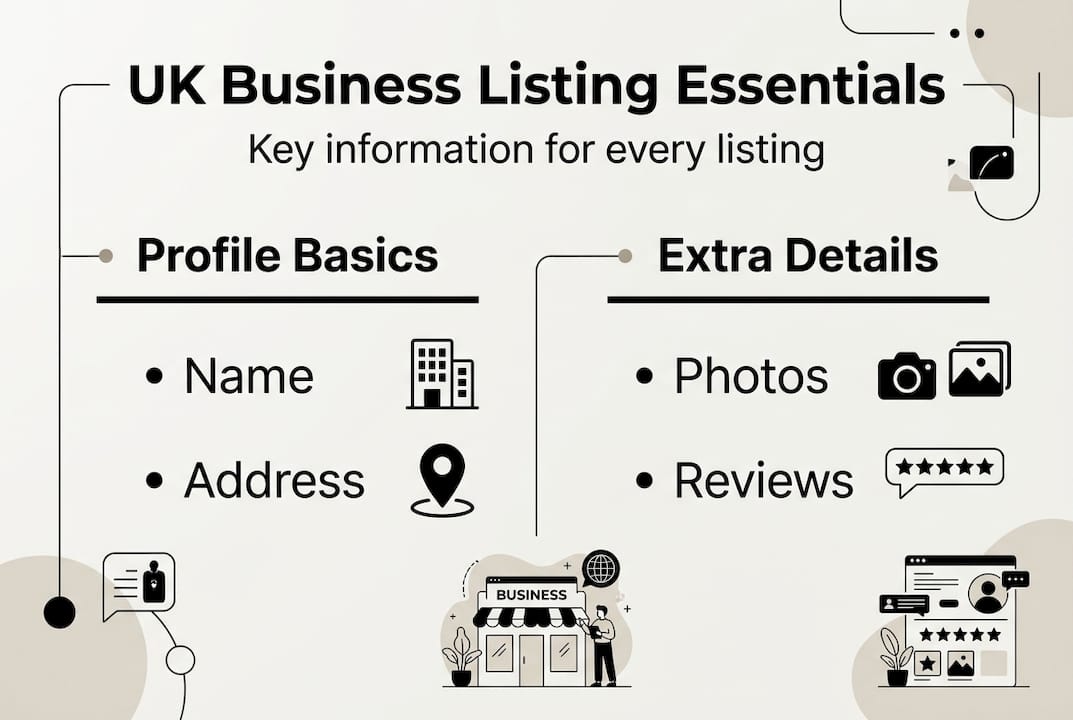
Review engagement serves dual purposes, boosting algorithmic favour whilst providing social proof that influences consumer decisions. Businesses that actively encourage reviews and respond professionally to both positive and negative feedback see measurable improvements in visibility. Google’s algorithm specifically considers review quantity, recency, and rating when determining local pack rankings. Beyond SEO benefits, reviews offer invaluable feedback for improving your services.
Technical SEO tactics like schema markup reinforce your NAP information at the code level. Adding LocalBusiness schema to your website creates structured data that search engines can easily parse, cross referencing it against your directory listings to confirm consistency. This technical layer strengthens your overall local SEO foundation, though most small businesses should focus on basic NAP consistency before diving into advanced markup.
Avoid these common pitfalls that undermine listing effectiveness:
- Submitting to low quality or irrelevant directories just to increase citation count, which can actually harm your reputation
- Using different business names across platforms, even slight variations like including or omitting “Ltd”
- Neglecting to update listings when you change phone numbers, move premises, or adjust opening hours
- Ignoring negative reviews rather than responding professionally to demonstrate customer care
- Keyword stuffing in business descriptions, which reads unnaturally and may trigger spam filters
Pro Tip: When encouraging customers to leave reviews, ask them kindly after successful project completion and make it easy by providing direct links to your Google Business Profile review page. Genuine, organic reviews carry far more weight than incentivised feedback and comply with platform guidelines.
For specialised trades like photographers, removal companies, or entertainers, industry specific directories offer targeted exposure to consumers actively seeking those exact services. Research which niche platforms your competitors use successfully, then claim your profiles there whilst maintaining strict NAP consistency with your core listings.
How local UK consumers and small businesses benefit: practical applications
Local consumers rely on accurate business listings to make confident hiring decisions without the risk of contacting unreliable operators or wasting time on outdated information. When searching for a trusted electrician or solicitor, listings provide instant access to verified contact details, customer testimonials, service descriptions, and often pricing guidance. This transparency empowers consumers to compare options efficiently, read authentic experiences from previous customers, and reach out to businesses that genuinely serve their area.
Small UK businesses gain transformative advantages from properly managed listings. Complete Google Business Profiles receive 7x more clicks than incomplete ones, translating directly to increased enquiries and revenue. With 46 to 50% of Google searches having local intent in the UK, your listing often represents the crucial first touchpoint with potential customers. Digital tool adoption among UK SMEs has surged 69% in recent years, yet many still overlook basic listing optimisation, creating opportunities for savvy businesses to gain competitive advantage.
Small businesses should follow this systematic approach to maximise listing benefits:
- Claim your Google Business Profile immediately, as this single action delivers the highest ROI of any local marketing tactic
- Audit your NAP information monthly across all platforms, correcting inconsistencies the moment you spot them
- Upload high quality photos showcasing your work, team, and premises to build visual trust and engagement
- Encourage satisfied customers to leave genuine reviews and respond thoughtfully to all feedback within 48 hours
- Keep opening hours meticulously updated, especially during holidays, to prevent customer frustration and lost business
Consumers searching for services should adopt these practices to find reliable providers:
- Verify business information appears consistently across multiple platforms before making contact
- Read recent reviews carefully, looking for patterns in feedback rather than fixating on isolated complaints
- Compare several businesses within your area using listings to assess experience, specialisations, and customer satisfaction
- Check photos to gauge professionalism and ensure the business maintains active, current profiles
For service businesses like painting services or cleaning services, listings function as a 24/7 salesperson, answering common questions and building credibility even when you’re unavailable to take calls. The convenience factor cannot be overstated, as consumers increasingly expect to research, compare, and contact businesses entirely online before making purchasing decisions.
“Businesses maintaining consistent NAP information across directories experience up to 70% increases in incoming call volume, whilst optimised profiles with complete information, photos, and reviews dramatically outperform competitors in local search rankings and customer conversion rates.”
The shift towards digital discovery means traditional word of mouth recommendations now often begin with online verification. Someone might hear about your carpentry business from a neighbour, but they’ll still search for your listing to confirm legitimacy, read reviews, and find contact details. Your online presence validates offline recommendations, making listings essential even for businesses that previously relied solely on referrals.
Get your business noticed with The Great British List
Small UK businesses seeking to enhance local visibility should leverage The Great British List, a trusted directory connecting service providers with consumers across the United Kingdom. Our platform offers specialised advertising categories tailored to trades and services, from photographers and painters to decorators and beyond, ensuring your business reaches the most relevant local audience actively searching for your expertise.
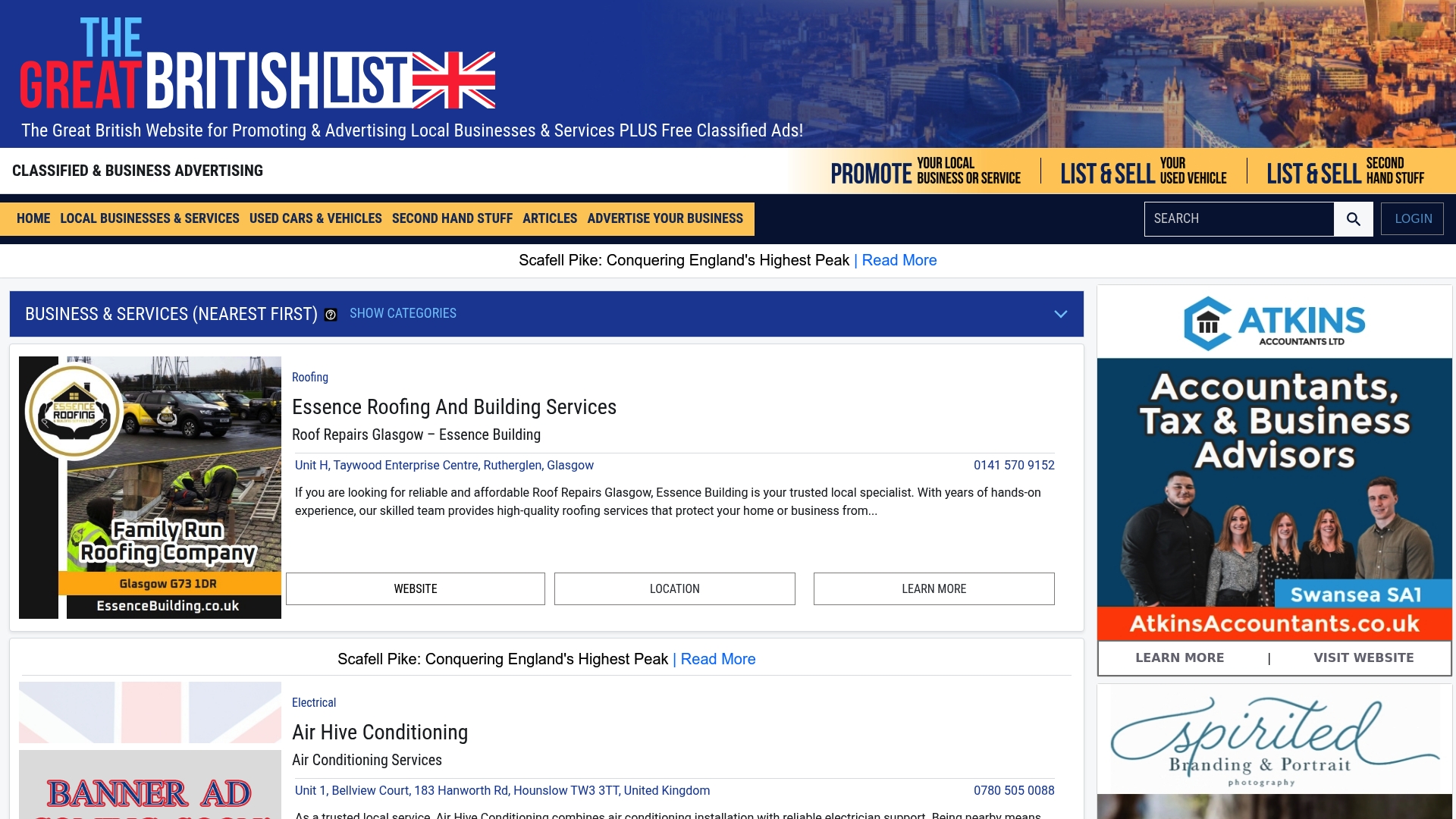
Claiming and optimising your listing on The Great British List complements your Google Business Profile and other directory presence, creating additional citation sources that strengthen your overall local SEO foundation. Our platform emphasises proximity based browsing, helping consumers find service providers nearest to their location whilst giving your business targeted exposure to ready to hire customers in your coverage area. Take control of your local visibility today by exploring our business advertising options and joining thousands of UK businesses already benefiting from enhanced online presence.
Pro Tip: Use The Great British List’s targeted categories strategically to reach consumers searching for your specific services, maximising the relevance and conversion potential of every profile view and enquiry you receive.
Frequently asked questions
What is a business listing?
A business listing is an online directory profile containing essential information like your business name, address, phone number, website, opening hours, service descriptions, photos, and customer reviews. These profiles appear on platforms like Google Business Profile, Yell, and Thomson Local, enabling local consumers to discover and contact service providers in their area. Well maintained listings improve your visibility in local search results whilst building trust through verified information and social proof.
How do I make sure my business listing is accurate?
Regularly audit all your listings at least monthly, checking that your name, address, and phone number match exactly across every platform. Use identical formatting for addresses and phone numbers, avoiding variations like “St” versus “Street” or different spacing in contact numbers. Verify your listings through each platform’s authentication process, complete all profile sections thoroughly, and immediately update any changes to your business details. Consider using a spreadsheet to track where your listings exist and when you last reviewed each one for accuracy.
Which UK business directories should I prioritise?
Google Business Profile stands as the essential starting point, offering free visibility in the world’s most used search engine and Maps application. Yell and Thomson Local provide strong UK specific exposure with free basic listings and optional paid enhancements for greater prominence. Beyond these core platforms, select industry specific directories relevant to your trade, such as specialist platforms for photographers, builders, or solicitors. Focus on quality over quantity, prioritising high domain authority directories that provide genuine citation value rather than submitting to hundreds of low quality sites.
Can business listings improve my search engine ranking?
Consistent NAP information across trusted directories significantly improves local search rankings by providing validation signals that search engines use to verify your business legitimacy and relevance. Citations from high authority directories function as trust signals, similar to backlinks, that boost your website’s credibility in search algorithms. Engagement metrics like review quantity, recency, and ratings directly influence Google’s local pack rankings, whilst complete, optimised profiles consistently outperform sparse listings. The combined effect of accurate citations, positive reviews, and comprehensive information creates a powerful local SEO foundation that elevates your visibility for relevant searches.
How often should I update my business listing details?
Audit and review your listings at least monthly to catch inconsistencies, verify information remains current, and monitor new reviews requiring responses. Update listings immediately whenever you change your phone number, move premises, adjust opening hours, or modify service offerings to prevent customer frustration and lost business. Respond to customer reviews within 48 hours to demonstrate active engagement and customer care. Regular updates signal to search engines that your business remains active and well managed, potentially boosting your rankings whilst ensuring consumers always find accurate, current information when they search for your services.