

Getting noticed locally is harder than it looks. You might have a great service, a tidy website, and happy customers, yet still find yourself invisible when someone nearby searches for exactly what you offer. Consistent NAP (name, address, phone number) across your listings can improve local pack rankings by up to 23%. That single fact tells you everything about why the right business listings matter. This guide walks you through the must-have UK directories, what makes them worth your time, and how to use them strategically to win more local customers.
Table of Contents
- What makes a business listing ‘must-have’?
- Tier 1 must-have business listings for UK businesses
- Tier 2 essential UK directories for added reach
- Comparison: Which listings drive the most results?
- Situational picks: Niche, service area, and AI search considerations
- How to list your business for best results
- Get your business listed on TheGreatBritishList.co.uk
- Frequently asked questions
Key Takeaways
| Point | Details |
|---|---|
| Focus on quality listings | Target 40-50 high-authority UK business directories with consistent details for the best SEO impact. |
| Prioritise tier 1 platforms | Always start with Google, Bing, Apple, and Yell.com for maximum visibility and trust. |
| Update and monitor regularly | Ensuring accuracy and responding to reviews keeps your listings effective and trustworthy. |
| Consider niche needs | Service-area or sector-specific businesses may require special or industry-focused listings. |
What makes a business listing ‘must-have’?
Not every directory is worth your effort. Some carry real weight with search engines and local consumers; others are little more than digital ghost towns. Understanding the difference saves you hours and gets you results faster.
A citation is simply any online mention of your business name, address, and phone number. Search engines use these mentions to verify that your business is legitimate and located where you say it is. The more consistent and trustworthy those mentions are, the better your chances of appearing in local search results.
Here is what separates a must-have listing from a forgettable one, according to criteria for must-have listings:
- High domain authority: The platform itself is trusted by search engines
- NAP consistency: Your name, address, and phone number must match exactly across every listing
- Search and map visibility: The directory appears in Google results and feeds into mapping tools
- Review integration: Customers can leave feedback, which builds social proof
- Relevance to your sector and location: A plumber in Leeds benefits more from a UK trades directory than a global one
- Mobile accessibility: Most local searches happen on phones, so the platform must work well on mobile
“40-50 high-quality citations outperform 100+ low-quality ones.” This is the golden rule of citation building. Fewer, better listings beat a scattergun approach every time.
Focus your energy on platforms that tick these boxes. A tiered approach, starting with the highest-trust platforms and working outward, is the most efficient way to build your local presence without wasting time on directories that add no value.
Tier 1 must-have business listings for UK businesses
These are the platforms you genuinely cannot afford to ignore. Every UK small business, regardless of sector or size, should have a complete, verified listing on each of these. Core Tier 1 listings for UK local businesses are Google Business Profile, Bing Places, Apple Business Connect, and Yell.com.
Google Business Profile (GBP) is the single most important listing you can have. It directly influences whether your business appears in Google Maps and the local pack (the map-based results at the top of a search page). GBP contributes 32% to local pack ranking factors, making it the heavyweight champion of local SEO. Fill every field, upload real photos, and collect reviews consistently.
Bing Places is growing in relevance faster than many business owners realise. With AI-powered search tools like ChatGPT and Perplexity increasingly drawing on Bing’s data, your Bing Places listing is now feeding into a much wider discovery ecosystem than it did even two years ago.

Apple Business Connect matters enormously for voice search and map-based discovery on iPhones and iPads. Apple Maps is the default on hundreds of millions of devices, and a verified listing here ensures you show up when Siri is asked for a local recommendation.
Yell.com remains a high-trust, UK-specific directory that both consumers and search engines respect. It has strong domain authority and a loyal user base, particularly among older demographics who still turn to Yell as a first port of call.
Here is a quick-start checklist for each Tier 1 platform:
- Claim and verify your listing officially
- Use your exact legal business name (no keyword stuffing)
- Add your full address or service area
- Include a local phone number, not a premium rate line
- Write a clear, honest business description
- Upload at least five quality photos
- Select the most accurate business category available
Pro Tip: A tiered approach to submissions means completing Tier 1 fully before moving on. A half-finished Google Business Profile does more harm than good. For inspiration on what a well-structured listing looks like, take a look at this garden services listing example on TheGreatBritishList.co.uk.
Tier 2 essential UK directories for added reach
Once your Tier 1 listings are complete and verified, these platforms extend your reach, strengthen your citation footprint, and sometimes connect you with niche audiences that the big platforms miss. Tier 2 essential UK directories include FreeIndex, Thomson Local, Scoot, 192.com, and Yelp UK.
- FreeIndex is particularly strong for small businesses seeking reviews and leads. It has an active user base and a straightforward review system that helps build trust quickly.
- Thomson Local has been around for decades and carries genuine authority. It feeds data into several other directories, meaning one listing can multiply your citation footprint.
- Scoot and 192.com broaden your data presence across the web. Many aggregator tools and smaller directories pull from these sources, so a listing here can quietly generate citations elsewhere.
- Yelp UK remains relevant in urban areas and certain sectors like hospitality, beauty, and fitness. If your customers are city-based or younger, Yelp is worth the effort.
Pro Tip: Do not rush into Tier 2 until your Tier 1 listings are fully optimised. Inconsistent NAP details spread across multiple directories can actually hurt your rankings. For trades businesses, a well-presented carpentry services listing or a removals listing shows exactly how detailed and category-specific your entries should be.
Comparison: Which listings drive the most results?
You have seen the tiers. Now let us put the main platforms side by side so you can make informed decisions about where to invest your time first.
| Platform | Trust level | Search visibility | Review integration | Best for |
|---|---|---|---|---|
| Google Business Profile | Very high | Excellent | Yes | All businesses |
| Bing Places | High | Growing fast | Limited | AI search reach |
| Apple Business Connect | High | Strong on iOS | No | Voice and map search |
| Yell.com | High | Good | Yes | UK consumer trust |
| FreeIndex | Medium | Moderate | Yes | Reviews and leads |
| Thomson Local | Medium | Moderate | Limited | Citation breadth |
| Scoot / 192.com | Medium | Moderate | No | Data aggregation |
| Yelp UK | Medium | Sector-specific | Yes | Urban and hospitality |
Key insight: 76% of near-me searchers visit a business within a day, and 46% of all Google searches carry local intent. These numbers make local listings one of the highest-return activities a small business can invest time in.
Google Business Profile dominates, but do not treat the others as optional extras. Bing Places is quietly becoming essential as AI search tools reshape how people find local services. Apple Business Connect is non-negotiable if your customers use iPhones, which in the UK is the majority. A decorators listing example on a well-structured directory shows how even a single, detailed listing can generate genuine enquiries.
The key takeaway from this comparison is focus. Completing five listings properly beats having twenty incomplete ones. Quality, consistency, and verification are what move the needle.
Situational picks: Niche, service area, and AI search considerations
The core list covers most businesses, but some situations call for a more tailored approach. Mobile businesses, tradespeople, and those operating across wide service areas have specific needs that standard directories do not always address.
- Trades and home services: Platforms like Checkatrade carry enormous weight for plumbers, electricians, and builders. Consumers actively seek out these specialist directories when hiring tradespeople, and a verified listing here signals credibility in a way that a general directory cannot.
- Mobile and service-area businesses: If you do not operate from a fixed premises, you need platforms that let you specify a service area without displaying a home address. Service-area businesses can use GBP and BrightLocal-recommended sites that allow hidden address and service area specification. This protects your privacy while still making you discoverable.
- AI search impact: Foursquare and Bing Places are increasingly relevant as tools like ChatGPT and Perplexity pull local business data from non-Google sources. If you want to appear in AI-generated local recommendations, diversifying beyond Google is no longer optional.
- Audit before you add: Before submitting to new directories, audit your existing citations. Old addresses, disconnected phone numbers, or misspelled business names create conflicting signals that confuse search engines.
Pair your citations with genuine customer reviews, structured data (schema markup) on your website, and basic on-page SEO. Citations alone are powerful; combined with these elements, they become transformative.
A photographer listing is a good example of how a creative professional can use a well-chosen directory to reach local clients who would never find them through a generic search.
How to list your business for best results
Knowing which directories to use is only half the job. How you set up and maintain those listings determines whether they actually deliver results. Follow this structured process and you will avoid the most common mistakes.
- Audit your existing listings. Search for your business name on Google, Bing, and the main directories. Note every place you appear and check for inconsistencies in your name, address, or phone number.
- Fix inconsistencies first. Correct any errors before adding new listings. Spreading inaccurate information further will make things worse, not better.
- Submit to Tier 1 platforms. Complete Google Business Profile, Bing Places, Apple Business Connect, and Yell.com fully before moving on.
- Move to Tier 2. Once Tier 1 is verified and complete, add FreeIndex, Thomson Local, Scoot, 192.com, and Yelp UK.
- Add niche directories. Based on your sector and service area, identify specialist platforms that your target customers actually use.
- Monitor and respond. Set a reminder to check your listings every quarter. Respond to reviews, update photos, and correct any details that change.
A structured, tiered approach to submissions, starting with core platforms and working outward to niche directories, consistently outperforms random or bulk submissions.
| Task | Frequency | Why it matters |
|---|---|---|
| Audit existing citations | Every 6 months | Catches outdated or incorrect details |
| Respond to reviews | Within 48 hours | Builds trust and signals activity |
| Update photos | Every 3-6 months | Keeps listings fresh and engaging |
| Check for duplicate listings | Annually | Duplicates confuse search engines |
| Add new platforms | As needed | Expands reach as your business grows |
For a practical example of a fully detailed listing, the cleaning services listing on TheGreatBritishList.co.uk demonstrates how thorough, category-specific information makes a real difference to how customers engage with your business.
Get your business listed on TheGreatBritishList.co.uk
Building a strong citation profile takes time, but you do not have to start from scratch. TheGreatBritishList.co.uk is a trusted UK business directory designed specifically to help local businesses get found by nearby customers. Whether you offer home services, trades, beauty, fitness, or professional services, a listing here puts you in front of people actively searching in your area.
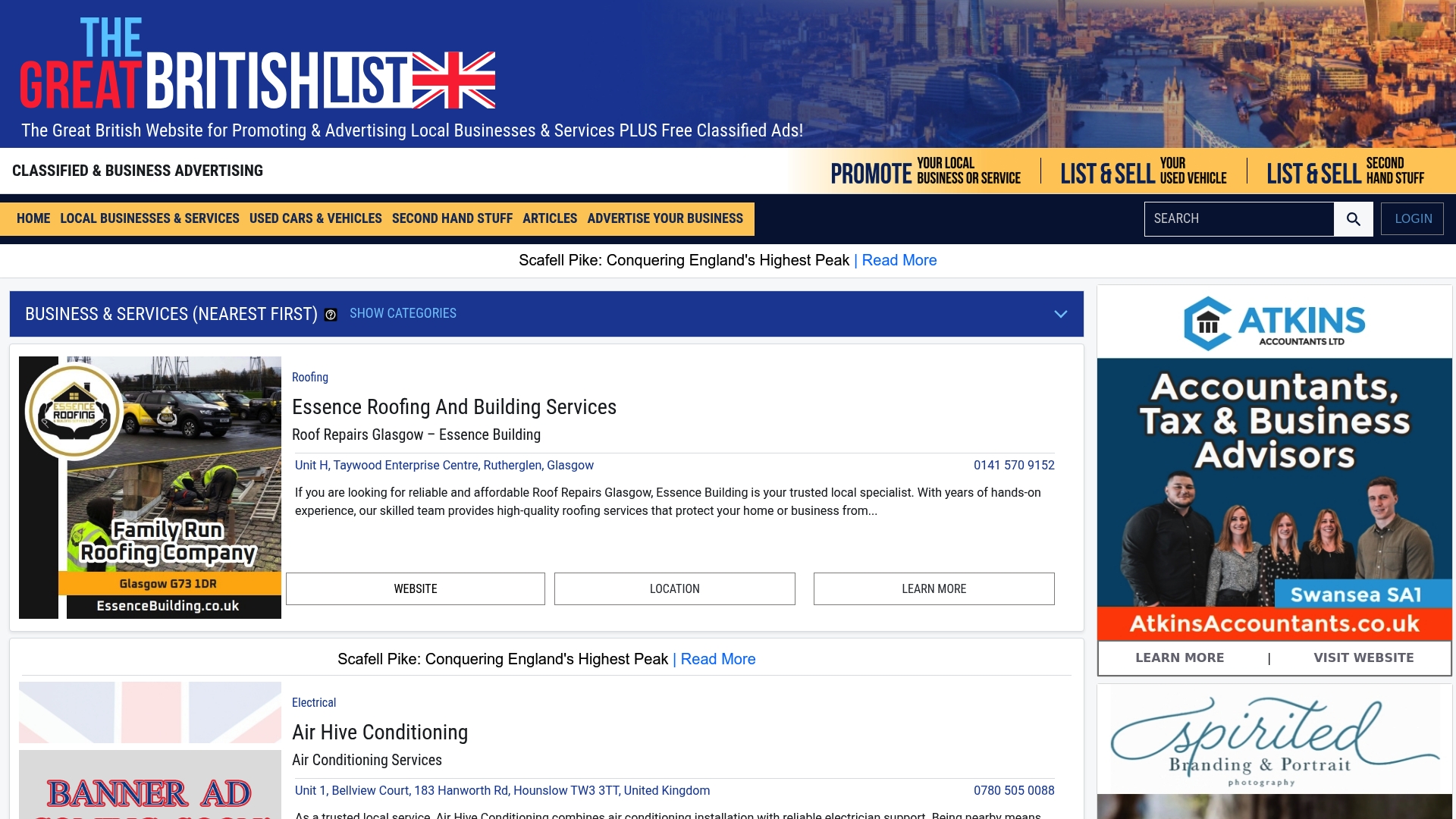
Listing your business is free, straightforward, and takes just minutes. You can add your full business details, service categories, contact information, and location so that local consumers can find you quickly. With proximity-based browsing and keyword filtering built in, TheGreatBritishList.co.uk connects the right customers to the right businesses. Add your free listing today and start building the local visibility your business deserves.
Frequently asked questions
How many business listings do I really need for UK local SEO?
Quality beats quantity every time. Aim for 40-50 high-quality citations, as these consistently outperform having over 100 low-value or inconsistent entries.
Which single business listing gives the biggest boost?
Google Business Profile is the most impactful, with 32% influence on local pack rankings. Claim and complete it before anything else.
Do I need different listings for a mobile or service-area business?
Yes. Platforms like GBP let you specify a service area without displaying your home address, which is ideal for mobile tradespeople and delivery-based businesses.
Is being on Yell.com or Thomson Local still worthwhile in 2026?
Absolutely. Both remain valuable for secondary visibility and local trust signals. Tier 2 directories like these strengthen your overall citation profile and reach audiences that Tier 1 platforms sometimes miss.
How often should I update my business listings?
Review your listings at least every six to twelve months to keep details accurate, and respond to new reviews promptly to maintain an active, trustworthy presence.
Recommended
- Find Removal Companies Near Me | House Removals & Man and Van
- Find Local Gardeners Near Me | Landscaping & Garden Services
- Find Photographers Near Me | Wedding & Event Photography
- Find Local Carpenters Near Me | Joiners & Carpentry Services
- Lokale Suchmaschinenoptimierung 2026: 73% mehr Sichtbarkeit - Hyped Performance Marketing Agentur
- Top 4 Local Search Optimization Tools 2026

.png)


.png)